TL;DR
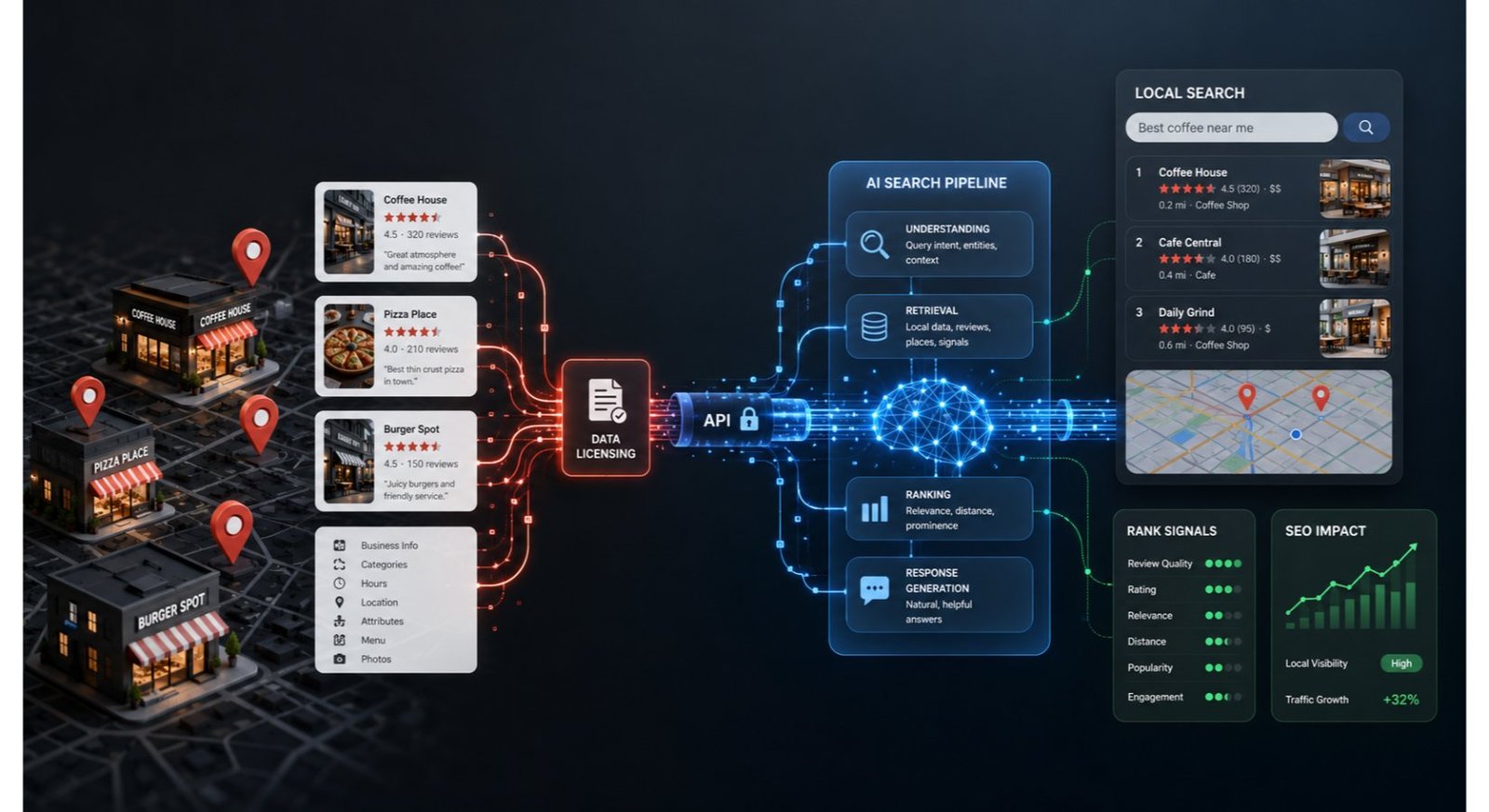
A technical analysis of Yelp’s data licensing deal with OpenAI reveals key insights into how ChatGPT handles local business queries and constructs its local search answers. Based on live API tests conducted on a ChatGPT Plus account, this summary outlines the structural mechanics of the local search pipeline and what local businesses must do to prepare.
- Yelp-OpenAI Data Licensing Deal: Yelp is licensing business details, reviews, ratings, and photos to OpenAI, with Yelp’s name and links appearing in ChatGPT answers.
- Non-Exclusive Terms: The data agreement is non-exclusive, allowing Yelp to license the same datasets to other search tools like Perplexity or Google in the future.
- Current Google Data Dominance: Prior to the Yelp integration going live, ChatGPT’s local business results rely heavily on Google Place IDs using the ChIJ… identifier format.
- Distinct Data Pipelines: Standard web search queries use vendors named bright, labrador, oxylabs, and serp, while local business queries utilize a separate system labeled b1 and serp.
- The “Near Me” Trigger: The dedicated local database pipeline is only activated by “near me” queries; location-specific queries like “coffee in Dubai” trigger a standard web search with a map overlay.
- Null Ranking Fields: The API payload reveals that both ranking_score and rank fields are returned as null, meaning ChatGPT’s local sorting algorithm remains hidden.
- Empty Review Highlights: The review_highlights field is currently empty, but is expected to fill with Yelp review texts once the licensed data goes live.
- The Hazard of Unanswered Reviews: Because LLMs paraphrase review text into natural language answers, unanswered well-written complaints could become prominent sentences in search results.
- Direct “Request a Quote” Integrations: Yelp’s quotation feature will allow users to message local businesses directly inside ChatGPT, bypassing the business’s own website entirely.
Yelp Data Licensing to OpenAI: Technical Analysis of ChatGPT’s Local Search Pipeline and SEO Implications
Yelp is licensing its reviews, ratings, photos, and business details to OpenAI. This commercial agreement, first reported by Axios on 23 July, marks a significant shift in how local data is ingested, processed, and displayed by artificial intelligence. Under the terms of the deal, Yelp’s brand name and direct links will show up within ChatGPT answers. Crucially, OpenAI retains full control over how that information looks and how it is integrated into the user interface. Because the deal is non-exclusive, Yelp retains the right to sell the same data assets to competing search tools like Perplexity or Google later on.
To understand what this means for local search engine optimization (SEO) and the broader search landscape, we must analyze how ChatGPT currently handles local traffic. Technical tests and API traffic captures performed on a logged-in ChatGPT Plus account in Dubai on 4 July 2026 provide an exact look at the backend data structures. These captures reveal that Yelp is selling its data into a slot that was already full of Google’s data. For local businesses, this means understanding the underlying data pipelines is critical to preparing for when the Yelp integration goes live.
Inside ChatGPT’s Local Search Traffic
Analyzing the data packets sent during a search query shows that local search works differently to the rest of ChatGPT. When a user conducts a normal web search, ChatGPT draws information from standard web indexing vendors. In the API traffic, these vendors are explicitly named as bright, labrador, oxylabs, and serp. These sources compile general web data to formulate standard conversational responses.
However, when a user searches for local businesses, the data arrives from an entirely separate system. In the captured local search traffic, these businesses came back from a data pipeline labeled as b1 and serp. Instead of general web scrapers, this dedicated local database pipeline returns highly structured JSON payloads containing specific business records. Every single business returned in these local results carried a Google Place ID, recognizable by the standard Google ChIJ… identifier prefix. This confirms that ChatGPT has been relying almost entirely on Google’s existing data infrastructure to generate its local recommendations. Yelp’s entry into this ecosystem represents an alternative data layer that will sit alongside or overlay these existing Google-derived business listings.
The Google Place ID Dominance
Before the Yelp data integration officially rolls out, the Google Business Profile remains the absolute source of truth for ChatGPT’s local search results. During the technical teardowns on 4 July 2026, a query was run asking which pharmacies near the user were open. The system returned 28 businesses. Every single one of those 28 pharmacy listings was bound to a Google Place ID.
This indicates that ChatGPT does not compile local listings dynamically from disparate web pages. Instead, it queries a structured local index where businesses are pre-mapped to Google’s database. Because Yelp is selling into a system already populated with Google Place IDs, the introduction of Yelp reviews, ratings, and photos will likely serve to enrich these pre-existing slots rather than completely replace them. Until a new provider name turns up next to b1 in the traffic logs, nothing has changed in the active traffic, and Google’s data infrastructure remains the dominant source.
Field-by-Field Analysis of ChatGPT’s Local JSON Payload
The JSON payloads captured during local queries reveal the exact fields ChatGPT uses to evaluate and display business listings. By analyzing these fields, we can see exactly what data is currently active and what remains empty, waiting for the Yelp integration.
Review Count and Rating
In the sample of 28 pharmacies returned during testing, each business record contained a real review count and an overall rating out of 5. The review counts ranged from a high of 422 down to a low of 4. These numbers are carried directly from the data provider into the system’s internal processing. Because review counts and ratings are two of the fields ChatGPT actively carries, a business with no reviews has no data to populate these slots, representing a severe disadvantage in search visibility.
Categories and Address
Each business listing in the payload includes specific category classifications and a structured physical address. This data is essential for ChatGPT to match businesses against specific user intents, such as identifying pharmacies, coffee shops, or plumbers.
Coordinates and Distance in Metres
The backend payload contains exact geographic coordinates (latitude and longitude) and a calculated distance in metres from the user. ChatGPT uses these coordinates to verify proximity, which is a core ranking factor in local queries.
Open Status
The system tracks whether a business is open at that exact moment. For queries looking for immediate services, such as open pharmacies, this real-time field determines whether a business is presented as a viable option to the user.
The Null Fields: ranking_score and rank
Some of the most useful insights come from the fields that returned empty. In both the initial local query and a second query that drew a map, the fields ranking_score and rank were both returned as null. This is a critical technical finding. Because these fields are null in the data stream, ChatGPT sorts the business list somewhere in its system that is not visible in the API traffic.
This means that if anyone tells you they know how ChatGPT ranks local businesses, they do not. The mathematical weights, scores, and sorting algorithms are processed in an opaque backend layer. We cannot state as a fact how the system orders these listings, only that it does so using parameters that are not exposed in the client-side API payload.
The review_highlights Field
Another field that came back empty was review_highlights. This field is designed to hold specific review text. Currently, because the field is null, ChatGPT lacks a structured stream of review text to pull directly into its localized summaries. This is exactly what Yelp sells. If this licensing deal works the way we expect, a new provider name will turn up next to b1 in the traffic logs, and the review_highlights field will start filling up with Yelp’s licensed review data.
The Mechanics of the “Near Me” Query vs. Location Searches
The technical teardown shows that the local pipeline only runs under specific search conditions. It is highly dependent on how the query is phrased and how location data is handled.
If a user searches for coffee “near me”, ChatGPT initiates the specialized local database pipeline, returning structured business lists, coordinates, and distances. However, if the user asks for coffee “in Dubai”, the system behaves differently. It runs a normal web search and places a map on top of the results. This hybrid web-and-map interface operates on a separate logic and does not utilize the same b1 local business pipeline.
Furthermore, the browser never sends the user’s precise physical coordinates to ChatGPT. Instead, the browser only transmits a timezone. Despite this limitation, ChatGPT is still able to identify the user’s specific neighbourhood. This indicates that ChatGPT’s backend system processes and resolves the precise geographical location on their end, probably utilizing the user’s IP address. While this IP-based processing is not confirmed as an absolute fact, it is the most likely technical pathway given that coordinates are not sent from the client-side browser.
Strategic Preparation for Local Businesses
Because the Yelp-OpenAI data integration is not yet live in the active traffic, local businesses have a critical window of opportunity to prepare. The strategy varies depending on geographic location and the active platforms in each market.
Maintain Google Business Profiles
For local businesses, nothing has changed in the active traffic yet. Every field ChatGPT actually uses for local results still comes from your Google Business Profile. Therefore, optimizing, updating, and maintaining your Google listing remains the absolute primary task for local search visibility.
Set Up Yelp Profiles in Active Markets
Yelp represents a secondary profile that businesses must set up, provided Yelp is used in your specific geographic market. The technical testing was conducted from Dubai, where Yelp is barely used, making this primarily a US story. If you operate in the US or another market where Yelp has an active presence, you must set up your page now, before the data goes live in ChatGPT’s system.
Build Review Velocity and Volume
Because review count and rating are two of the fields ChatGPT actively carries in its payload, a business with zero reviews will have empty fields. If you have no reviews, you run the risk of not being included in the dataset at all. This is a much worse problem than simply ranking poorly. Businesses must actively gather reviews on their Yelp profiles to ensure that when the data pipeline switches over, their profiles are fully populated.
Answer Bad Reviews to Manage LLM Synthesis
Business owners must answer their negative reviews, but not just for customer service reasons. Once the review_highlights field begins filling with Yelp review text, large language models (LLMs) will read these reviews and synthesize them into natural language search answers. The LLM will summarize the sentiment in its own words.
If a business has an unanswered complaint that is well-written, that complaint is highly likely to be processed by the LLM and turned into a permanent, descriptive sentence in someone’s local search result. By responding to negative reviews constructively, businesses can influence the textual context that the LLM reads, mitigating the risk of negative automated summaries.
The “Request a Quote” Shift and Website Traffic Loss
There is another critical part of the Yelp-OpenAI agreement that extends beyond reviews and ratings. Yelp’s “Request a Quote” feature is going to be integrated directly into ChatGPT. This transaction-focused feature will allow users to contact local service providers, such as plumbers, electricians, or contractors, without leaving the chat interface.
This integration represents a structural shift in the customer journey. Instead of clicking a link in the search results, visiting the local business’s website, and filling out a contact form, the user can complete the entire enquiry process directly within the conversational interface of ChatGPT. While this may increase lead volume, it takes the enquiry off your website entirely. Local businesses must prepare for a future where website traffic decreases as transactions are consolidated within the AI search interface itself.
Monitoring the ChatGPT Research Tracker
The transition from a Google-only local data layer to an integrated Yelp-OpenAI dataset is an active process. Technical analysts will continue to capture and analyze the traffic payloads to identify exactly when the data goes live. Any changes, provider shifts, or field updates will be documented in the ChatGPT research tracker. Until the provider name next to b1 changes and the review_highlights field begins displaying Yelp’s proprietary data, Google Business Profiles remain the primary driver of ChatGPT’s local search answers.